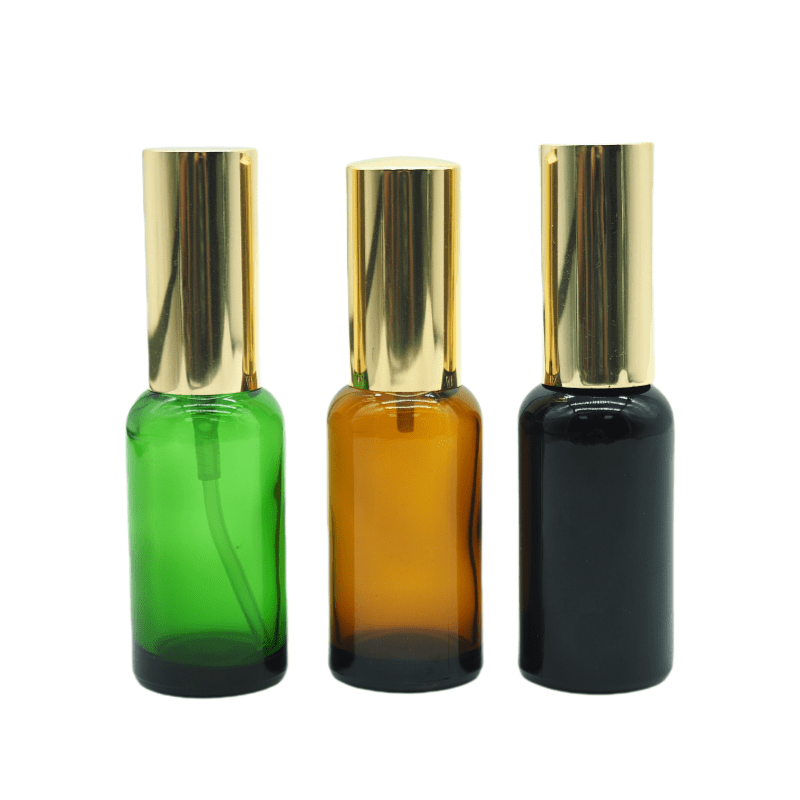
In the high-value botanical market, the “Expiration Date” is often determined not by the oil itself, but by the container. When a brand sources an essential oils bottle, they are sourcing a chemical shield.
Essential oils are volatile, complex mixtures of terpenes, esters, and aldehydes. They are reactive. The two primary enemies of these compounds are UV Radiation (Photo-oxidation) and Oxygen (Peroxidation).
This analysis explores the material science required to extend the shelf life of your inventory. We will deconstruct the spectral capabilities of essential oil dropper bottles versus roller bottles for essential oils, the dangers of “painted” glass in the 2026 supply chain, and how to engineer a packaging system that maintains therapeutic potency from the warehouse to the vanity.
The Spectrum of Decay: Understanding Glass Filtration
Not all colored glass is created equal. When purchasing essential oils bottle stock, buyers are often presented with a spectrum of Amber, Blue, Green, and Violet. This is not a palette; it is a filtration chart.
1. Amber Glass (The Sulphur-Carbon Shield)
Amber remains the pharmaceutical gold standard for a specific reason: It is a “Blue Light Blocker.”
- The Physics: Amber glass is created by adding iron, sulfur, and carbon to the silica melt.
- The Performance: It absorbs nearly all radiation below 450nm. This includes UV-B (burning) and UV-A (aging), as well as high-energy blue visible light.
- The Application: For citrus oils (Bergamot, Lemon) which contain Limonene and Citral, Amber is mandatory. These molecules degrade rapidly into skin-sensitizing peroxides when exposed to blue/UV light.
2. Cobalt Blue (The Selective Filter)
Roller essential oil bottles are frequently sold in Cobalt Blue.
- The Physics: Created with Cobalt Oxide.
- The Performance: Unlike Amber, Blue glass does allow some UV light and significant Blue light to pass.
- The Strategy: It is less protective than Amber. However, in 2026, it is preferred for “stable” oils (Peppermint, Lavender) or blends where the aesthetic value outweighs the slight risk of oxidation. It is not recommended for cold-pressed citrus oils unless the bottle is kept in a secondary box.
3. “Violet” / Black Glass (The Biophotonic Standard)
A growing trend in premium essential oil dropper bottles is “Violet” (or Miron-style) glass.
- The Theory: This glass blocks the entire visible spectrum except for Violet and Infrared light.
- The Claim: Manufacturers claim this specific light frequency “energizes” the organic molecules, extending shelf life from months to years. While scientifically debated, it commands the highest price point in the luxury market.
The “Fake Color” Epidemic: Painted vs. Bulk
A critical risk in the 2026 supply chain is the prevalence of Painted Glass. To save money, factories produce clear glass bottles and spray them with Amber or Blue lacquer.
- The Trap: A painted essential oils bottle looks identical to a genuine one.
- The Failure Mode:
- Chemical Stripping: Essential oils are solvents. If a drop spills on the neck during filling, it will dissolve the paint, leaving a clear streak and contaminating the user’s hands with dissolved lacquer.
- Zero UV Protection: Most colored paints are transparent to UV radiation. They provide the look of protection without the physics of protection.
- The Protocol: Always scratch-test your samples. If you scratch the blue surface and see clear glass underneath, reject the batch. True “Furnace Glass” is colored all the way through.
Roller vs. Dropper: The Oxidation Variable
When choosing between roller bottles for essential oils and essential oil dropper bottles, you are choosing between two different oxidation risks.
The Dropper Risk: “Headspace Exchange”
Every time a user squeezes the bulb of a dropper:
- They dispense oil.
- They release the bulb, sucking fresh Oxygen into the bottle to replace the liquid.
- The Consequence: By the time the bottle is half empty, the remaining oil is sitting in a bath of fresh oxygen, accelerating spoilage.
- The Fix: For expensive, easily oxidized oils (like Rose Otto or Blue Tansy), advise customers to keep the bottle tightly capped and consider smaller volume bottles (5ml instead of 15ml) to ensure the product is used before oxidation sets in.
The Roller Risk: “Back-Contamination”
Roller essential oil bottles have a different vulnerability.
- The Mechanism: The ball rolls onto the skin, picks up dead skin cells, bacteria, and sebum (skin oil), and rolls them back into the bottle.
- The Consequence: The “Cloudy Effect.” After 3 months, the oil inside the roller looks murky. This is bacterial growth.
- The Fix:
- Formulation: Roll-on blends must contain an antioxidant (like Vitamin E / Tocopherol) and be robust enough to handle bacterial introduction.
- Fitment Tightness: A tighter tolerance housing (less gap) minimizes the amount of “back-flow” re-entering the bottle.
Case Study: The “Solar Citrus” Recall
This case study illustrates the catastrophic failure of using the wrong glass for the wrong oil.
Subject: Lumina Botanicals (Name anonymized), a high-end organic skincare brand.
The Product: “Morning Sun” – A pure, cold-pressed Grapefruit and Bergamot serum. The Packaging: To stand out, they chose clear essential oil dropper bottles that were “Frosted” (acid etched) to look like sea glass. They believed the frosting would diffuse the light enough to protect the oil.
The Incident: Retailers placed the product on lighted glass shelves. Within 4 weeks, customers complained of “burning” and “rashes” upon application.
The Science: Grapefruit oil contains Furocoumarins, which are phototoxic. Because the glass was clear (white frosted), UV light penetrated easily. The UV radiation reacted with the Limonene in the oil, converting it into Limonene Hydroperoxide—a potent contact allergen. Effectively, the packaging had turned a soothing serum into a chemical irritant.
The Pivot: Lumina recalled 10,000 units. They switched to “Glossy Black” (UV-Opaque) glass.
- The Result: The black glass blocked 100% of the light. The Limonene remained stable for 24 months. The brand rebranded the line as “Dark-Housed Actives” to turn the packaging change into a marketing feature about potency preservation.
The Engineering of the Cap: The “Vapor Barrier”
An often-overlooked component of the essential oils bottle is the liner inside the cap. Essential oils are “creepers.” They have low surface tension and will climb up the threads of a bottle.
The Liner Hierarchy
- PE Foam (Standard): Good for water. Fails with oils. Essential oils eventually saturate the foam, causing it to deform and leak.
- Cone Liner (Polyseal): A wedge-shaped plastic cone. Excellent for essential oil dropper bottles (if using a cap without a bulb). It wedges into the glass neck ID.
- Teflon (PTFE) Faced: The professional standard. A thin layer of Teflon faces the liquid. Nothing sticks to it, and nothing permeates it.
- The 2026 Spec: For roller essential oil bottles, the cap must have a “depression ring” inside that physically pushes down on the roller ball to immobilize it. If the cap doesn’t touch the ball, the ball will rattle and leak during shipping.
2026 Trend: The “Refill” Eco-System
A major shift in 2026 is the decoupling of the “Dispenser” from the “Reservoir.” Brands are selling:
- The Hardware: A premium, heavy-weighted stone or metal case that holds a standard glass vial.
- The Refill: Simple, capped essential oils bottle vials (Amber, Tubular glass) that the customer inserts into the hardware.
- The Benefit: The brand only ships the lightweight refill glass. The consumer keeps the heavy roller mechanism.
- The Requirement: Precision. The glass vials must be DIN 18 or GPI 400 standard to ensure they fit universally into the reusable cases.
Conclusion
The selection of an essential oils bottle is a scientific decision that directly impacts the efficacy of the formulation.
- If your oil is Citrus, you must use Amber or Opaque glass to prevent peroxide formation.
- If your oil is a Carrier Blend, you must verify the Roller Gap to ensure flow.
- If your brand values Purity, you must verify the glass is Furnace Colored, not painted.
For the B2B buyer in 2026, the bottle is the guardian of the molecule. By treating the packaging as a photonic filter and a bacterial barrier, you ensure that the “Drop of Nature” you sell is exactly what the customer receives.