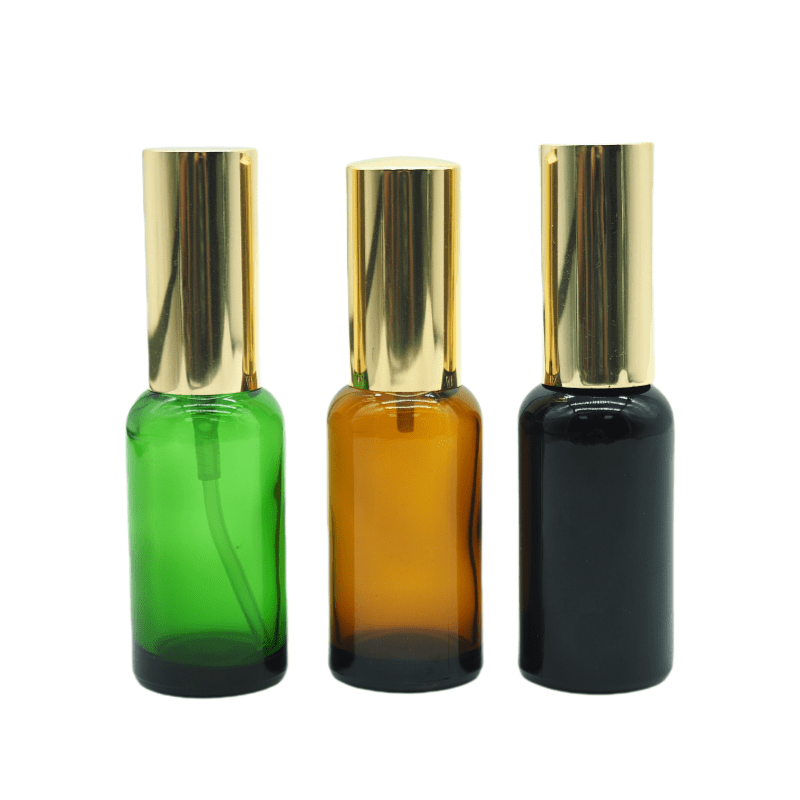
In the B2B glass market, there is an axiom: “You don’t pay for the glass; you pay for the tolerance.”
When a brand owner browses a catalog for an essential oils bottle, the difference between a $0.15 unit and a $0.22 unit often seems negligible. Visually, they look identical. However, in an automated filling line running at 60 bottles per minute, that $0.07 difference reveals itself in the form of “Line Jams,” “Cap Back-off,” and “Label Flagging.”
This analysis explores the operational reality of sourcing essential oil dropper bottles and roller bottles for essential oils. We will deconstruct the specific manufacturing defects that cause production line failures, the “Labeling Curve” physics of small vials, and the logistical protocols required to ensure your inventory arrives clean and intact.
The Geometry of Failure: Out-of-Round Necks
The most common, invisible defect in budget glass is the “Out-of-Round” (Ovality) neck.
The Dropper Crisis
Essential oil dropper bottles rely on a precise interaction between the glass threads and the plastic cap threads.
- The Defect: If the glass mold is worn out, the neck cools into a slightly oval shape rather than a perfect circle.
- The Impact: When your capping machine applies torque:
- The cap cross-threads (goes on crooked).
- The cap “strips” (spins endlessly without tightening).
- The Leak: Even if it feels tight, the ovality leaves a microscopic gap between the liner and the glass rim. Oxygen enters; oil exits.
- The 2026 Spec: You must specify a “T (Thread) Dimension Tolerance” of +/- 0.15mm. Anything looser will cause a 5% failure rate on high-speed lines.
The Roller Crisis
For roller bottles for essential oils, ovality is catastrophic for the fitment.
- The Impact: The fitment is a perfect circle. If the glass neck is oval, the fitment will be squeezed on the narrow sides and loose on the wide sides.
- The Result: The fitment pops out during air travel (pressure changes) because it isn’t gripped uniformly by the glass.
Decoration Dynamics: The “Flagging” Label Problem
A major trend in 2026 is the miniaturization of packaging (5ml and 10ml samples). However, labeling a small essential oils bottle presents a physics problem.
The Stress Memory of Labels
- The Physics: Paper and BOPP (plastic) labels have “memory”—they want to lie flat. When you wrap them around a tight radius (like a 10ml roller), the label fights to uncurl.
- The Failure: “Flagging.” The edges of the label peel up 24 hours after application.
- The Cause:
- Wrong Adhesive: Using a standard acrylic adhesive instead of a “High-Tack” rubber-based adhesive.
- Surface Treatment: Glass is hydrophilic. If the glass bottle has a “Cold End Coating” (an industrial wax used to prevent scratching during shipping), the label adhesive cannot bond to the glass.
- The Protocol: When buying roller essential oil bottles for labeling, ask the supplier: “What is the dyne level of the surface?” or request “Label-Ready Treatment” where the anti-scratch wax is minimized.
The Alternative: Silk Screen Printing
To avoid flagging entirely, premium brands are moving to Silk Screen Printing.
- Epoxy Ink: Cheaper, glossy. Good for standard oils.
- Ceramic Ink: The ink is fused into the glass at 600°C.
- Why Ceramic? Essential oils are solvents. If a user drips pure Lemon oil on an Epoxy-printed bottle, the text might smear. Ceramic ink is permanent and impervious to all chemical attacks.
The Assembly Trap: Glued vs. Mechanical Droppers
When sourcing essential oil dropper bottles, you have two assembly options for the cap/bulb/pipette.
1. The Glued Assembly (Avoid)
Cheap manufacturers use glue to bond the rubber bulb to the plastic cap.
- The Risk: Glue overflow. If the glue drips down into the cap, it can touch the pipette. Over time, essential oil vapors dissolve the glue, contaminating your organic product with industrial adhesives.
2. The Mechanical Interference Fit (Preferred)
High-quality droppers use a “flange and groove” system. The rubber bulb has a lip that snaps into a groove in the plastic cap.
- The Benefit: Zero glue. Zero contamination risk.
- The Check: Pull on the bulb. If it pops out with a “snap,” it’s mechanical. If it tears or leaves residue, it’s glued.
Roller Fitment Engineering: The “Push-In” Force
For roller essential oil bottles, the manufacturing line efficiency depends on the “Push-In Force.”
If you are using an automated machine to insert the rollers:
- Force < 3kg: The fitment is too loose. It will leak.
- Force > 8kg: The machine has to press too hard.
- Risk: The vertical pressure cracks the glass neck.
- Risk: The machine jams/stops.
- The Calibration: You must send samples of your roller bottles for essential oils to your filling machine manufacturer before buying 100,000 units. They need to calibrate the “insertion hammer” to match the specific friction tolerance of the fitment.
Supply Chain Logistics: The “Egg Crate” vs. “Shrink Wrap”
How the glass arrives at your facility determines your cleaning costs.
The “Egg Crate” (Carton Divider)
Bottles are placed in open cardboard boxes with dividers.
- Pros: Cheap.
- Cons: “Paper Dust.” The friction of transport creates fine cardboard dust that settles inside the essential oils bottle.
- Cost: You must run these bottles through an ionized air rinser or vacuum cleaner before filling.
The “Shrink-Wrapped Module” (The Clean Pack)
Bottles are sealed in plastic bricks (e.g., 12 x 10 rows) inside the carton.
- Pros: The bottles are sterile and dust-free upon opening.
- Cons: Slightly higher material cost.
- ROI: For small brands without expensive air-rinsing machinery, this is the only viable option. The labor cost of manually blowing out dust from 10,000 bottles far exceeds the surcharge for shrink-wrapping.
Case Study: The “Travel Set” Disaster
This case study illustrates the risk of “Spot Market” sourcing.
Subject: Nomad Scents (Anonymized), a travel-focused aromatherapy brand.
The Context: Nomad sourced 50,000 roller essential oil bottles (10ml Amber) from a “Spot Market” trader to save $0.02 per unit. Spot market glass is often “Overrun Stock” from various different production runs mixed together.
The Incident: Nomad’s automated labeler started jamming. The labels were being applied crookedly on 20% of the bottles.
The Forensic Analysis: The “Spot Market” batch contained bottles from two different molds.
- Mold A: Straight cylindrical body.
- Mold B: Slight taper (conical) body. Visually, they looked the same. But mechanically, Mold B caused the bottle to wobble as it spun on the labeling machine.
The Pivot: Nomad switched to “Contract Production” glass.
- The Protocol: They paid for a specific “Single Gob” production run. This meant every single bottle came from the same mold cavity, guaranteeing 100% dimensional consistency. Labeling efficiency went from 80% to 99.9%.
2026 Trend: The “Heavy Bottom” Aesthetic
In the luxury sector, the essential oils bottle is gaining weight. Standard 15ml bottles weigh about 30-35g. “Heavy Bottom” (Heavy Sham) bottles weigh 55-60g.
- The Psychology: Consumers equate weight with value.
- The Optical Effect: The thick glass bottom acts as a lens, refracting the color of the oil (Amber or Blue) and making the bottle appear to glow on the shelf.
- The Engineering: These bottles require slower cooling times in the annealing lehr to prevent internal stress cracks in the thick base. Ensure your supplier performs a “Polariscope Stress Test” to verify the heavy bottom is stable.
Conclusion
Sourcing essential oil dropper bottles and rollers is not a commodity purchase; it is an engineering integration.
- If you label: You must check the surface dyne level and glass straightness.
- If you cap: You must check the neck ovality.
- If you automate: You must verify the fitment insertion force.
In 2026, the smart B2B buyer looks for the “Total Cost of Quality.” A cheap bottle that jams your line, ruins your labels, or leaks in a customer’s pocket is the most expensive packaging you will ever buy.